
Run any Model Context Protocol (MCP) server: securely, instantly, anywhere.
ToolHive includes everything you need to use MCP servers in production. Rather than build or combine components yourself, use ToolHive's Registry Server, Runtime, Gateway, and Portal to get up and running quickly and safely.
ToolHive keeps you in control of your MCP estate. Integrate with popular clients in seconds and deploy pre-vetted MCP servers in locked-down containers with a single click or command. ToolHive is available as a desktop app, web app, CLI, and Kubernetes operator.
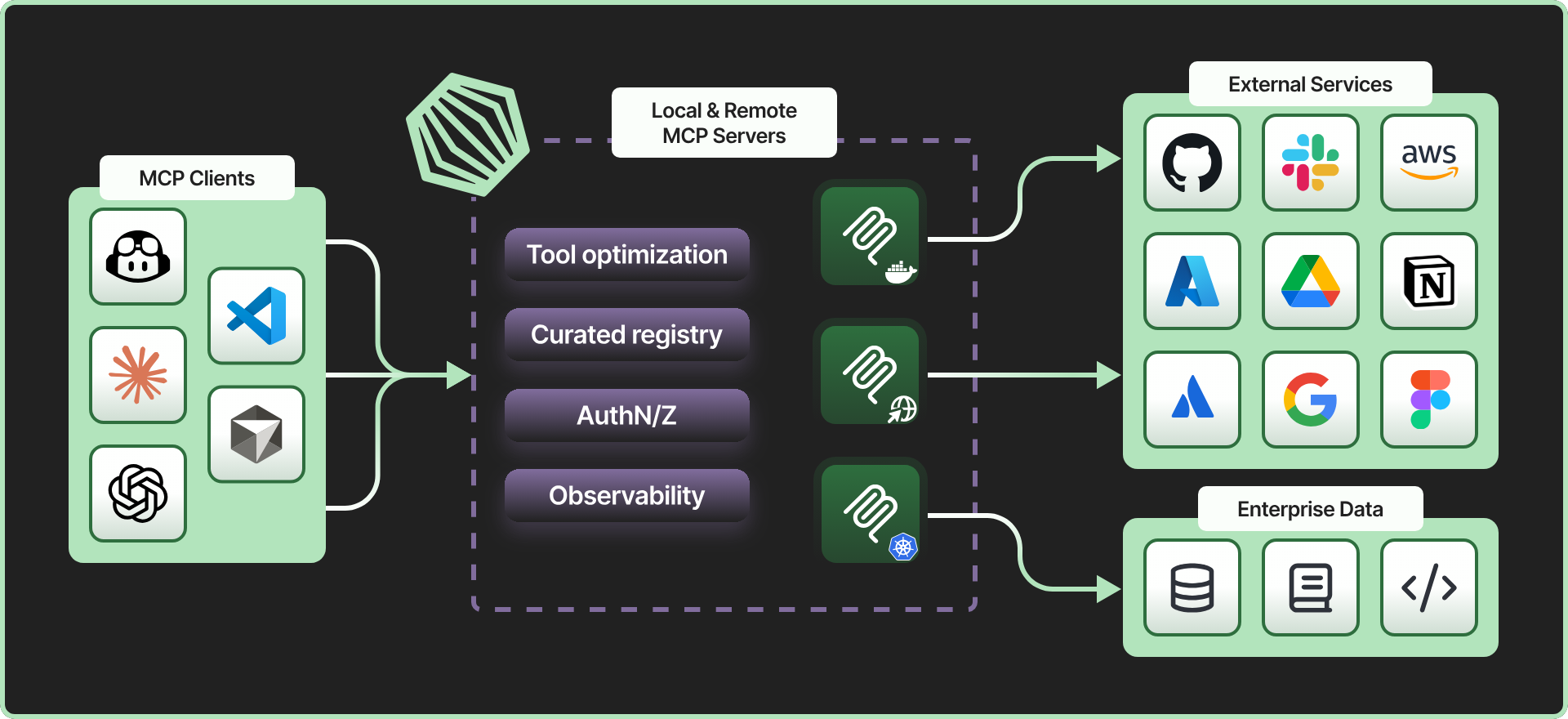
The Model Context Protocol (MCP) has unlocked a powerful new way to extend AI systems with tools, data sources, and execution environments. But as teams move from experimentation to production, a familiar problem appears: running MCP servers safely, consistently, and at scale is harder than it should be.
ToolHive exists to solve that problem.
Rather than treating MCP servers as one-off experiments glued together with scripts and ad-hoc infrastructure, ToolHive provides a complete, opinionated platform for running MCP servers securely—whether that’s on a developer laptop, inside Kubernetes, or across a hybrid enterprise environment.
The Problem with “Just Run the Server”
Spinning up an MCP server is easy. Running dozens of them across teams, environments, and clients is not.
Most organizations quickly run into the same set of challenges:
- Security drift: Secrets end up in environment variables, containers run with broad permissions, and provenance is hard to verify.
- Operational sprawl: Each MCP server has its own deployment model, configuration style, and lifecycle.
- Client friction: Developers waste time manually wiring servers into tools like Copilot, Cursor, or Claude Desktop.
- Governance gaps: There’s no clear way to define access policies, audit usage, or control which servers are approved.
ToolHive addresses these issues by treating MCP servers as first-class infrastructure, not side projects.
A Platform, Not a Pile of Scripts
ToolHive is built around a modular but tightly integrated architecture:
- Gateway – The secure front door. It defines endpoints, applies authentication and authorization, enforces policy, and orchestrates multiple tools into deterministic virtual MCPs.
- Registry Server – A curated catalog of trusted MCP servers. It supports upstream registries, custom servers, role-based grouping, and signed provenance.
- Runtime – The execution layer. MCP servers run in locked-down containers locally (Docker/Podman) or in Kubernetes, with observability baked in.
- Portal – The user experience. A desktop app, web UI, and CLI that make discovering and installing MCP servers a one-click operation.
This separation of concerns keeps security, access control, and operational logic centralized—while still giving developers the flexibility they need.
Secure by Default, Not by Policy Document
One of ToolHive’s core design principles is that the safest option should also be the easiest.
Every MCP server launched through ToolHive runs:
- In an isolated container with only the permissions it needs
- With encrypted secrets that never appear in plaintext
- With explicit network boundaries
- With audit logging and metrics via OpenTelemetry and Prometheus
For Kubernetes users, the ToolHive Operator extends this model with CRDs that fit naturally into existing GitOps and platform workflows. Fleet management, multi-namespace isolation, ingress integration, and SSO via OIDC/OAuth are built in—not bolted on.
Determinism Matters for Agents
As MCP usage becomes more agentic, predictability matters.
ToolHive’s Gateway includes a deterministic workflow engine that allows teams to:
- Compose multiple tools into a single virtual MCP
- Control execution order and tool visibility
- Filter descriptions to reduce token usage
- Apply organization-wide policies consistently
This means agents behave the same way in production as they did in testing—an underrated but critical property when AI systems start making real decisions.
From Laptop to Enterprise Without Rewrites
ToolHive is intentionally designed to scale horizontally across environments:
- Individual developers can start with the desktop app or CLI in minutes.
- Teams can graduate to Kubernetes using the same mental model and configuration patterns.
- Enterprises can run hybrid setups, mixing local MCP servers, cluster-hosted services, and trusted remote providers.
The same registry, runtime, and security controls apply everywhere.
That continuity is what allows ToolHive to support everything from solo experimentation to enterprise governance without forcing a rewrite at each stage.
Built for the MCP Ecosystem
ToolHive doesn’t try to replace the MCP ecosystem—it amplifies it.
It integrates with the official MCP registry, supports hundreds of AI clients, and includes tools like the MCP Inspector and Optimizer to help teams test, validate, and tune their servers.
The project itself is fully open source, Apache-licensed, and actively developed, with a growing contributor base and frequent releases.
The Bottom Line
MCP servers are becoming foundational infrastructure for AI systems. Treating them as disposable scripts is no longer enough.
ToolHive provides a practical answer: a secure, production-ready platform that makes running MCP servers easy for developers, safe for organizations, and predictable for agents.
Or, put more simply: ToolHive makes deploying MCP servers easy, secure, and fun without compromising on control.
